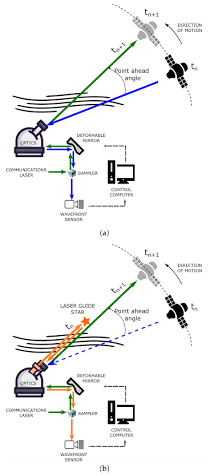
Correcting Atmospheric Turbulence
Adaptive Optics (AO): Ground telescopes use high-speed wavefront sensors to measure how the atmosphere distorts incoming light pulses. A computer calculates the error and drives a flexible, motorized deformable mirror thousands of times per second. By physically flexing to match the exact inverse shape of the atmospheric distortion, the mirror flattens the light before sending it to the photodetector. Aperture Averaging: Instead of a tiny optical sensor, ground stations use larger receiver telescopes (or arrays of multiple smaller telescopes). Collecting photons across a larger physical area averages out localized dark spots caused by air turbulence. Forward Error Correction (FEC) & Interleaving: Turbulence can cause "fades"—milliseconds-long drops in signal strength. Signal processors use mathematical algorithms (interleaving) to break up data streams and scatter packet bits over time. When a temporary signal drop occurs, FEC algorithms reconstruct the missing bits on arrival.
Let's Connect
Whether you’re interested in our services, have a question, or just want to chat about the exciting world of space and technology, we’d love to hear from you! At World Space, we believe in the power of connection and collaboration. Reach out to us, and let’s explore how we can work together to achieve great things. Connect with us via email, social media, or our contact form—we’re here to help.
Looking For The Best Digital Agency & Marketing Solution?
Lorem ipsum dolor sit amet, consectetur adipisicing elit. Laborum obcaecati dignissimos quae quo ad iste ipsum officiis deleniti asperiores sit.
Contact Us